
Rozsika Parker’s The Subversive Stitch: Embroidery and the Making of the Feminine addresses the relationship between women and embroidery. It is interesting to me that embroidery became the defining aspect of what it meant to be feminine, where it was proper for women to sit at home and stitch. Pity the woman who couldn’t or wouldn’t. Further than that, it seems very clever to have turned that expectation on its head, as domestic crafts have been used in protest throughout history; as Parker posits, embroidery has “provided both a weapon of resistance for women and functioned as a source of constraint. It has promoted submission to the norms of feminine obedience and offered both psychological and practical means to independence” (1) and Figure 2.
She goes on to point out that embroidery was always done for others - as an act of care- and to embroider for oneself was the epitome of selfishness. And yet, when sewing together, a woman could use the social bonds to escape the feeling they were neglecting her family.
This book made me stop on several occasions to think deeply about what was written. Not the least of these moments was pondering the power of the needle - to repair and to capture the voice of the women using it. Yet, in its power, stitching became a domestic craft and thus divorced from art. In writing this book, Parker exposes the historic devaluing of embroidery and reasserts its importance and value. She completes her work with the thought that whilst embroidery’s association with the feminine has restricted its development as an art form, the frameworks in which it is undertaken have shifted. Embroidery is not carried out as a domestic duty and may often be made by a ‘career’ woman… although not in the workplace.
Parker discusses a program in the UK called Fine Cell Work, where prison inmates (men) were given materials to learn to embroider. This program seemed to produce a positive mental state in the prisoners and a shift in the relationships between the inmates. Psychological growth and development of creativity were byproducts of the embroidery and stitching. One prisoner is recorded as saying, “I find the quality of work soothing, and I am saving for my release” (2)
As I was reading this book, I felt that much of what was written could be applied to other ‘crafts’ such as knitting and crochet. Knitting has long been considered a feminine domestic craft, only to be engaged in as care for those around them. I think of my own mother, who knitted 17 jumpers for my Dad before they even got married!
I am especially interested in knitting as a form of communication for my research into how trauma sits in the body and the potential for repair. The Fine Cell Work program seems to me to be an outworking for the repair of not only trauma but self-esteem. It has made me think and wonder how I might use my knitting to this effect.
(1) Parker, Rozsika. 1984. The Subversive Stitch: Embroidery and the Making of the Feminine. In Internet Archive. London: Women’s Press. xix https://archive.org/details/subversivestitch00park.
(2) Parker, Rozsika. 1984. The Subversive Stitch: Embroidery and the Making of the Feminine. In Internet Archive. London: Women’s Press. xxi https://archive.org/details/subversivestitch00park.
https://aeon.co/essays/when-womens-needlework-becomes-an-act-of-subversive-protest
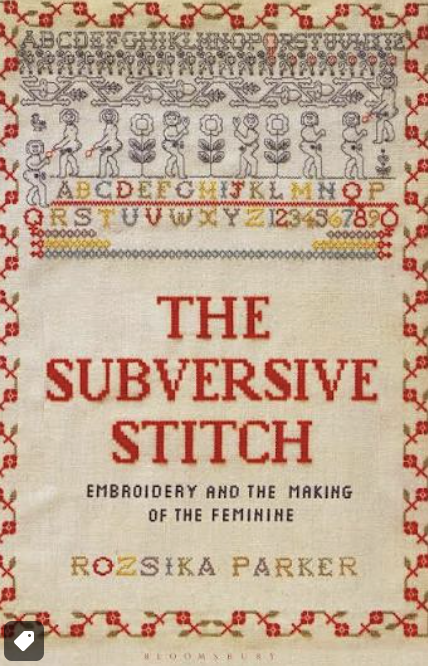
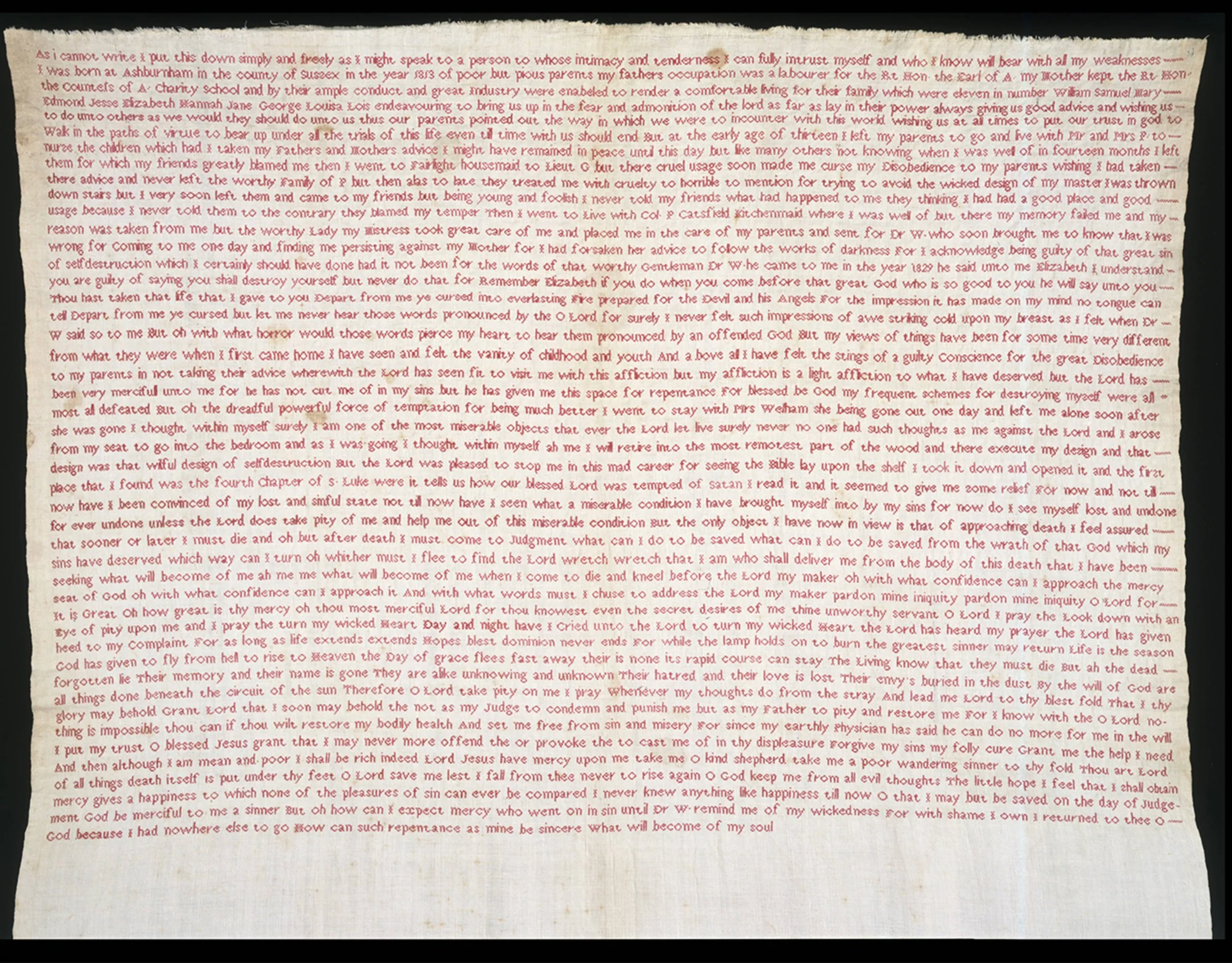
Figure 2. A unique confessional text-only sampler made by teenager Elizabeth Parker around 1830, who had been working as a nursemaid. Parker's text describes what she sees as her weaknesses and sins, her cruel mistreatment at the hands of her employers, and an abortive plan to kill herself, though thankfully, she actually died in 1889, aged 76.
https://www.vam.ac.uk/articles/embroidery-a-history-of-needlework-samplers